











You get a single team handling cybersecurity, IT, and data integration services like EDI, filling the gaps in your team.

“Corsica is a one-stop shop for us. If I have a problem, I can go to my vCIO or a number of people, and you take care of it. That’s an investment in mutual success.”
– Greg Sopcak | Southern Michigan Bank & Trust
From 24/7 SOC services to MDR/SIEM, penetration testing and training, we’ve got you covered.
Get the expert support you need for your network, on-premises devices, VoiP, M365, Google Workplace, and everything in between.
Full support of compliance frameworks, including CJIS, HIPAA, CMMC, NIST, SOC 2, and more
Cut through the hype with smart strategies and right-fit AI solutions for your organization.
Take strategic steps with confidence as you collaborate with our expert business and vCIO consultants.
Get cloud security, integration, server virtualization, and optimization strategies to reduce your cloud costs.
Connect any data source to any other with robust solutions and managed services.
Stay ahead of the curve, eliminate waste, and grow revenue with next-generation technologies.
Expert consulting, implementation, integration, managed services, and cybersecurity for Microsoft products.
One program. One partner. Complete AI transformation.
It takes dedicated experience to use technology strategically in your industry. That’s why we specialize in certain verticals while offering comprehensive technology services.
From webinars and video tutorials to guides and blogs, we’ve got resources to help you and your team address any technology challenge.
We’ve got a better way.
Specialized managed services from EDI experts, backed by the operational power of a world-class MSP.

EDI enables businesses to exchange documents like invoices and purchase orders digitally, streamlining operations and reducing manual errors.
For midmarket companies, EDI integration automates communication with trading partners, supports formats like EDI, EDIFACT, and cXML, and connects seamlessly with ERP and eCommerce systems.
Managed EDI services typically include mapping, onboarding, and support—helping IT teams stay focused on strategic goals while ensuring secure, compliant data exchange.
Complex requirements call for expert managed services—yet not all EDI solution providers offer a great experience for their customers. We talk to companies who suffer from:
What if you could find an EDI partner with a deep background in managed services?
What if you could get it all for a predictable monthly cost?

Our affordable EDI service packages go far beyond break/fix. You get dedicated service applied to the continuing growth of your EDI program and your required B2B integration. Depending on the complexity of the new requirement, your managed service can cover:
Only larger projects require an SOW. You get predictable cost and reliable data flow to keep your business running smoothly—and growing.
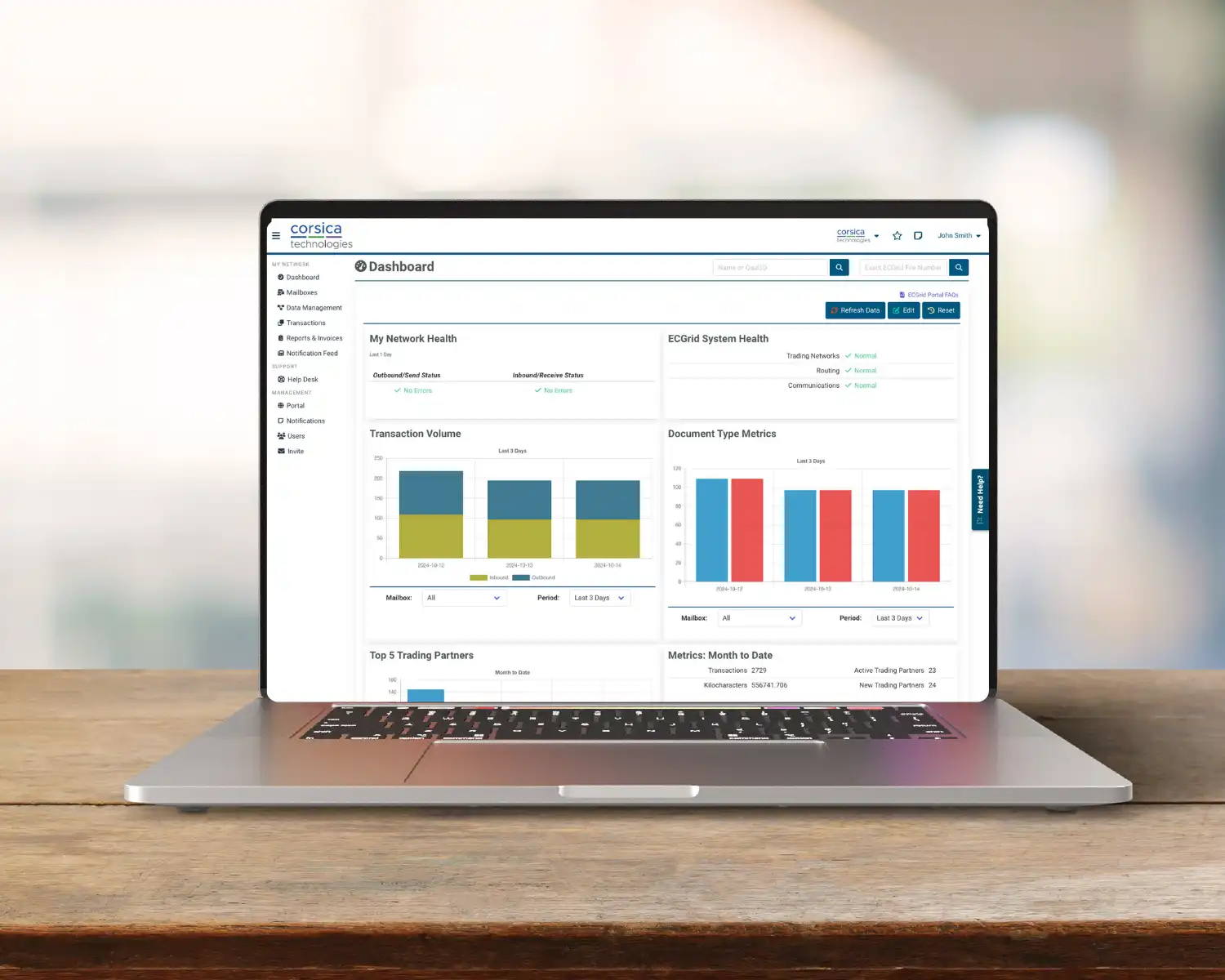
Corsica Integration Cloud, our proprietary platform, connects any data source to any other. As an EDI integration platform, it gives you cohesive B2B data across your operations at one flat price.
EDI integration is the process of connecting an EDI solution to one or more additional software systems, such as ERP, SCM, or WMS. This allows companies to exchange EDI documents with trading partners, automatically sending and receiving data to and from additional systems with the appropriate formatting.
EDI integration can occur in real time or through periodic batch updates, depending on your requirements. Successful integration requires an EDI integration solution maintained by expert technicians.


—Christina Holmes | Co-Founder, Skulicity
—Eric Borsky | Business Systems Analyst | PetWise Brands

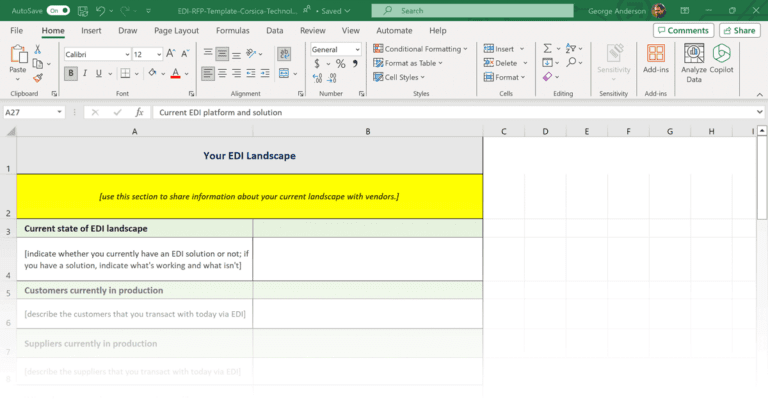
Cover all your bases with our comprehensive template. From technical requirements to billing structure, our template empowers you to evaluate vendors in the cold light of day.
EDI, data integration, data exchange, is a business critical process to the mid-market as much as it is to a larger enterprise. Mid-market companies that need this service need to match that with a company or provider that's uniquely focused on that market. Welcome, everyone, to Unraveling IT. And today, we're gonna be taking a deep dive into EDI and specifically its impact on the mid-market. My name is Peter Rodenhauser, chief operating officer here at Corsica. And joining me today is Bob Renner, senior operating partner at Inverness Graham. Bob, also happens to be a former colleague and great mentor to me. So I'm excited to have Bob here on the podcast today. And, Bob, if you wouldn't mind giving a brief overview of your background in this space since it's, significant, and, and then we'll get into the discussion. Yeah. Thanks, Peter. So, yeah, I helped, found a company that some of you guys may have heard of, Liaison Technologies. That was a business that was focused not only on EDI, but data integration in general. Did that for a good long time, longer than I care to share, I guess. It's, almost two decades. Dates me a little bit. But, yeah, saw a lot of ups and downs in the industry, solved a lot of really important challenges for companies, and just glad to be here, with Peter today, kinda getting current with, you know, what's going on in the market. Yeah. Current. You know, when you think about the you think about the past twenty plus years in in this space, and I know we both have over 20 years in in this space specifically, a lot's changed. So maybe we start there and, talk a little bit about the evolution of, the B2B integration space and some of the various technologies and really how it's been implemented, and how it's supported, you know, businesses at various sizes. Yeah. I think that that'd be a good background, Peter. Fast forward almost 25 years now from when I first kinda heard of EDI and the challenges people are facing and look at all the different ways vendors have tried to help companies solve that. It's gone through an evolution. So it started out as a kind of full service offering, counting kilo characters and, you know, helping with really basic connectivity. You know, about, I think, probably 15 years ago now, there is the introduction of iPaaS, integration platform as a service, which was a self-service model that said, listen, let's enable the IT organizations to do a lot of this work theirself. And as it turns out, that that did kind of eat into, I guess, the, let's call it, traditional EDI market a little bit, particularly with the API integration that people were experiencing as they move their applications to the cloud. But at the end of the day, you know, here we are, many years later, still talking about EDI as the main event. It still dominates the market. It's still the style of integration that everyone uses. And frankly, the self-service component of that, really never took hold. It's a little bit more of a complicated environment to support for IT organizations. And so they've really kinda gone full circle, in my opinion. When you look back, it was initially a full service type offering. The economics got out of whack a little bit. People looked to do self-service type work. And now it's really back to, let's find some experts in the market that can help us with that. So, you know, I think we can pick up on some of those themes, but that's the Reader's Digest version of the lineage of a, you know, 40, 50-year, evolution from the first, you know, thoughts of how to do EDI. So it's kinda interesting. Yeah. For sure. For sure. And, you know, it's funny. You mentioned, it all comes back to EDI. I know when I got into the space, one of the first things I heard was that, you know, EDI was gonna be dead in a few years. And I said, oh, boy, I'm just starting my career. I don't know if I want to start in the field of a technology that's about to die, but here we are. And, it's still very much alive and well. You know, you mentioned you mentioned iPaaS, and, you know, when iPaaS came out, you know, 15 years ago, as you said, you know, it had high hopes, both in terms of its capabilities and technology and how it was gonna really ease, some of the integration for companies. What are you, you know, what are some of the key lessons learned in that in that iPaaS era that, you know, you've seen, you some of the companies really take a look at and now start this next evolution or phase? Well, what's happened, in my opinion, is there's two themes that are running parallel, and they're diverging in a way. And these new technologies kind of help to converge those a little bit. And what I mean by that is the environments become more and more complicated. Right? So this complexity component on data integration, including EDI, and variants thereof, continues to grow. And so new technologies like iPaaS that have some self-service, have some automation built into those, We're really introduced to kinda help bring that complexity under control and help people to deal with that as they're connecting now to cloud apps, they're connecting to traditional trading partners, they're working in the supply chain, they're using it to enable their ecommerce platforms, and moving up the stack to look at the data that's actually being moved in these in these packets of information between these systems. So I think what iPaaS did is it said, I'm gonna be able to simplify all this. I'm gonna make this go away. You're never gonna have to do a map again. You're never gonna have to have a third-party provider that helps you from the EDI perspective or with integration perspective because we're gonna make it all cookie cutter. Patterns of integration will be developed, and you'll just apply those patterns and move forward. What it really did is what I was talking about before. It just reduced some of the complexity in that overall system, But enough residual remained that the traditional ways of using, service providers, now managed service providers, to really jump in and deal with the more holistic problem of interoperability between systems, between companies, and across supply chains still exists. So if you look at the size of the iPaaS market compared to the overall data integration market, it's still very small. It was exciting. It helped with some of this complexity, empowered people to do some self-service work. But at the end of the day, that might have chipped off, you know, 10 or 15 percent of the use cases, maybe a little more because they redefined iPaaS over time to be enterprise iPaaS, that looks a lot more similar to the legacy platforms that were out there, frankly. A little more, holistic, a little more, pervasive in what they could support. But but, yeah, I think that's what iPaaS did. So now with that really a mature, part of the market and the vendors have matured and consolidated in that area, we're really back to the to the same problem, growing complexity, growing volumes of data exchange, EDI as a durable format that's being used for variety of the use cases, and there's new use cases being added every day that that have different styles of integration. So we're just, as a group, trying to keep up with this. Right? And iPaaS, I think, helped a little bit along the way. Excellent. Yeah. So iPaaS, from a technology perspective, certainly solved some problems and some challenges, but not all the problems. And here we are still with, you know, some of the same challenges and problems. And a big one of those is, you know, how we solve, you know, some of the B2B EDI, integration challenges or broader data integration challenges with the technology. And that that brings us to the managed service model. And I think, you know, the managed the technology has evolved a bit, but but so has the managed service, delivery model as well in terms of how, you know, this technology is being deployed and managed. You know, there's a variety of providers out there, from, you know, some focus purely on the technology. So let's talk a little bit about that. If, you know, managed service seems to be, this this gravitational force of how B2B integration is most commonly being deployed today. I think a lot of that has to do with, of course, the fact that for many organizations, mid-market in particular, it doesn't make sense to house, those technical expertise in house. So, you know, finding that that provider makes a lot of sense. What are what are you seeing in terms of the managed service offerings, you know, today versus, you know, even 15 years ago? No. Yeah. And I think you're right. I think everybody's come to the realization the next great opportunity for automation, which I think will help kind of like iPaaS did to reduce the complexity will be AI or some variant thereof. But in the meantime, there's been a predictable evolution on managed services. So how did managed services and EDI come about? It started out with, you had platform providers that that provided connectivity between, end users and trading partners that had to exchange data. And they had to map that data to make it interoperable and usable by both systems. Their goal was very much like a SaaS business. Right? It was to be low touch, to leverage the platform, to expand their gross margin. Right? Because they're trying to push as much data through the platform so they could amortize the cost of building these expensive platforms and having these data centers over a lot of transactions and a lot of customers. The only reason why they pivoted to providing some form of managed services, and I call it a lightweight managed services, was to grab more share of wallet from these customers, essentially. So there were, there were support aspects to that. So when something broke and that needed to be fixed, there was some diagnostic on data that was bad that would fail validation and things like that. So they took elements of what we would call a more comprehensive managed service and packaged it up into another recurring revenue source. But they really, over time- very predictable- have pushed back towards less and less service, covering less and less scope of what, say, you and I or somebody like the Corsica would think of as a complete managed service. Right? So the MSPs or the managed service providers really emerged because it's a variant of business process supporting your desk supporting your desktops off your plate so you don't have to hire people and so on. The EDI providers that tried to provide an approximation of that have tried to say, what's the minimum level of scope that I can provide, to get a little more share of wallet from these customers and maybe take some of the dubious effort or dubious activities off their plate. What they didn't do is say, hey. Hey. Anytime you need to set up a new trading partner, anytime you need to create a new map, this is all gonna be included in our comprehensive managed service. So they approach the problem very differently than a managed service provider, a pure managed service provider would. Pure managed service provider is saying, let me make this turnkey. You never have to spell EDI. You don't have to talk about it. You don't have to worry about it. You don't have to pay me incrementally every time I do a task that might be, quote, unquote, out of scope. I'm gonna wrap an umbrella around this, and I'm gonna provide an offering to you. The EDI providers looked at it very differently. They said, what is the- what is an augmentation to this transaction processing platform that I have, which is super low touch. I do very little. If I do more, I charge you as a project. And you can see that when you look what I- I've recently become a customer, which is very funny. One of the portfolio companies I work with, I've had to be on the other side as a customer of an EDI service for the first time in my life. And seeing what was out of scope was very eye opening to me, in terms of what they call managed service compared to what a managed service provider, would include in that scope. So I think that's the big difference on how this is evolving. The transaction processing platforms have added a little bit of service around it so they can charge an additional monthly fee, and provide some value in all fairness, but it's but it's on the margin. And then managed service providers, I think, are waking up to, hey, we've got all the infrastructure to do this. We got the people, the processes. We source the best of breed technology and apply that, to the customer. Why not do that for EDI? Why not do that for data integration? You know, it's still a mission critical activity, and we can do it in a way that's different than an incumbent EDI provider, for example. That makes sense. So in in summary, you know, there's two categories of providers, if you will. One are our technology providers that are- have attempted to wrap a managed service offering, which is more secondary, just not the priority of the business, that gets maybe diluted over time. But, you know, in in the managed service space, managed service providers like a Corsica, you know, we really lead with our expertise. We are providing expertise and services for our customers and really wrapping the technology solutions that best fit for them. But we have that managed service delivery model and, you know, and really that is the expertise and the discipline, that suits that mid-market best. So that makes good sense. Yeah. I would add to that just really quick, Peter. Yeah. And you touched on that, and I think I breezed past it. When you're dealing with the EDI provider in that managed services capability, you can use any solution or any software as long as it's theirs. Right? I mean, in all fairness, that's what that's what their bread and butter is, their software, their platform, their network. The MSP is in a different place where as that market is so dynamic and things are changing, technology is changing, you can adopt the best technology to fit the type of service - and customer profile that you're trying to fit. So it gives you a unique advantage, and it's an advantage that MSPs have used for the other categories of services. So, you know, Cisco, F5, all the checkpoint firewalls, all those things come in and out of favor as the best solution from a price performance standpoint. The MSP can be somewhat indifferent and resell, support, implement, the products that are gonna be best, a best fit for their ideal customer profile. That's true for EDI and other data integration as well. So it's a unique positioning that I think somebody like a Corsica can come at, that the EDI providers themselves cannot. They're just too, committed, too invested in their own technology. Yeah. I think that's a really good point. You know, when I when I look across our customers, I mean, we have customers that are that are, you know, some are using on-premise translators, even different translators. Some are using cloud-based solutions. Some are using different bands. But how we are delivering the service and providing the expertise is consistent, and, you know, as a consistent wrapper around all that. So that makes good sense. How about from a, you know, I'll say maybe from a vertical industry, you know, perspective, anything that you are seeing, you know, we talked about the mid-market maybe at large, but, you know, are you seeing any differences in different verticals, in this space, or is it, you know, fairly, fairly consistent, fairly horizontal, in terms of the challenges. Yeah. It's interesting. This hasn't changed from my perspective in the last about seven to ten years that the vertical market specificity really only vests, in my opinion, in health care and health sciences right now. I mean, all the other major markets, albeit they may have some uniqueness to them, they've really kinda come to the conclusion that 85 percent of what they do is pretty common. So financial services, you know, manufacturing is not a vertical, but it's a process that has some consistency, retail. They've all moved on to kind of a more generalized EDI, and data integration type solution set. And as I said, they may have bolt-on components around the catalog, things that are upper-level type of, solutions that are not just moving and moving of data and interoperability data. The data persistence and reporting gets a little more unique. But healthcare continues to believe they're different. They have different standards, different terminology. And so they've eluded the, the big players to some degree. They still they still use some of the consolidated EDI players, but they do have a lot of, let's call it, very specific, players in that market that focus on health care and life sciences, primarily health care. So other than that, the vertical specificity, at least from what I've been able to ascertain, is, it's pretty much gone away. And it's kind of settled on, hey. You know, moving an EDI document or moving a or connecting to an API interface, regardless of if it's a financial services system or a retail system, is similar enough that we don't have to have a special cottage industry around providers for that or software. Yep. Yep. Absolutely. Yeah. And, you know, similar enough, but not to belittle the importance of it because, you know, something consistently I hear from all of our customers and even prospects that we speak with, is just the importance of the data itself that's being moved. You know, these EDI transactions are oftentimes the lifeblood. And that brings us back to, you know, how these solutions are being managed, how they are supported is so, so critical, because it's the businesses really depend on this data. So, as we wrap up here, you know, today, the listeners- most of the listeners of this podcast are midsized organizations. You know, if you were to, you know, summarize your recommendation, to midsize companies that, you know, maybe are looking to get into, B2B EDI, you know, in the first place, right now, or maybe they are going through or coming up on, you know, an ERP migration where they're gonna have to relook at some of their, some of their maps where, you know, maybe that's a good time for them to look at a new service provider. You know, what's your recommendation for them as to how to really look at the offerings that are available and where they should spend their energy? Yeah. Peter, I think that's a good point. We did touch on the mid-market, and I'll go, you know, a little bit deeper as we wrap up here on that. Is, you know, the large enterprises, and I mean, you know, the the larger enterprises, don't have a corner on business critical processes. And EDI, data integration, data exchange, is a business critical process to the mid market as much as it is to a larger enterprise. However, a larger enterprise is more statistically significant to the service providers generally that cover the whole ecosystem. So if you go to one of the leading EDI value added networks, they're gonna care a little bit more about an Amazon's network a lot more about and focus a lot more on an Amazon's needs or a Walmart's needs or whatnot than a mid-market company that equally is dependent as dependent on this kind of a capability. So I do think there is a not only a need, but I think there's an emerging recognition that mid-market companies that need this service and other mission critical services need to match that with a company or provider that's uniquely focused on that market. And I think that's where Corsica is. I think that's where you're focused. There may be others that focus in that area as well. But the needs of the mid-market are almost just a, miniaturization of what an enterprise needs. But over and over and over, I see the larger providers trying to group all the mid-market, companies that they support into, like, a ubiquitous cohort and say, you know, we have, you know, XYZ company. We have, you know, GM as one of our customers, and we have this mid-market. Well, each one of those mid-market companies IS a company, and they need to be treated the way they should be, as an individual company with special needs. They need attention. So my call out to the mid-market is, they're being lost in the shuffle. As this market is consolidated and people are pushing to increase their margins and deal with the macro level economic challenges of the current market or environment, they're being left behind. And they really need to look for a provider, that's focused in on the mid-market. They need services to be tailored to them. They need to be treated as an important customer. So I think that's one thing that if you're a mid market customer and you're not feeling important, for your EDI services or other services, you probably have a mismatch, between the service provider and what you're trying to accomplish in your business. And it might be a good time to, you know, poke your head up and look around and see what else is out there. That's great advice. That's great advice. And, yeah, and great great insight into, you know, how, the various the various players are really targeting and supporting their existing, you know, customers. So very helpful. Well, Bob, I wanna thank you for your time today. It's my hope that this is part one of a multi part series of having you join as a guest on the podcast. I know you're, you're a busy guy and have a lot going on, but, it's really helpful, you know, for our audience to hear, from someone with such a deep expertise in in the space and, you know, you have the opportunity to work and, you know, speak with a lot of different companies in the space still. So, really appreciate the insights today. Thank you so much for your your time and, and thank the the audience, for tuning in today to the podcast, and looking forward to the next Unraveling IT podcast. Yeah. Thank you, Peter. I enjoyed it. And I'm happy to come back anytime. Okay. All right. Thanks, Bob.
Our managed EDI services include mapping, integration, and ongoing solution management (people, process, and technology) for our EDI integration platform. You get automated exchange of transaction documents like:
Easily integrate to the suppliers and buyers who matter most. Our platform supports all popular B2B EDI message formats, routing protocols, and applications.

You get career EDI experts working under the operational structure and service commitments of a world-class MSP.
No more metered charges for every exception and change. Your service empowers you to grow EDI with your business.
We’re also an MSSP. Engage us for managed security alongside EDI, and you’ll get a cohesive approach to critical technology.
| Criteria | Corsica Technologies | EDI Software Vendor | MSP |
|---|---|---|---|
| Marketplace Recognition | ✅ Trusted by regulated industries and integration-heavy businesses | ✅ Known for robust technical platforms | ⚠️ Strong in infrastructure, weak in integration expertise |
| Reliability / Uptime | ✅ Dependent on chosen platform (e.g., Cleo, ECGrid, Xebec) | ✅ High availability within proprietary platforms | ❓ Dependent on third-party tools and partners |
| Support / Customer Service | ✅ U.S.-based, 24/7, consultative support | ⚠️ Focused on ticket-based, platform-centric support | ⚠️ Often lacks data integration support experience |
| EDI Integration Expertise | ✅ 20+ years of deep EDI/data integration experience across leadership and delivery | ✅ Strong technical tools but limited managed services | ❌ Typically lacks deep integration capability |
| Compliance Support | ✅ HIPAA, GLBA, CMMC, and industry-aligned security frameworks | ⚠️ Compliance features exist but require client oversight | ❌ Often lacks compliance alignment beyond infrastructure |
| Customization & Flexibility | ✅ Flexible onboarding and integration strategy tailored to client needs | ⚠️ Fixed platform-driven models | ⚠️ Rigid offerings with limited integration flexibility |
| Onboarding & Implementation | ✅ Guided by seasoned integration consultants | ⚠️ Focused on platform provisioning | ❌ May lack onboarding support for integration-specific workflows |
| Vendor Consolidation | ✅ Single partner for managed IT, EDI, security, and support | ❌ Requires coordination with other providers | ❌ Often limited to network/server services |
| Data Transformation / Mapping | ✅ Advanced transformation logic and ongoing optimization | ✅ Strong mapping tools, but minimal service guidance | ❌ Rarely supports transformation or EDI translation |



“I have very few IT related headaches and scares when it comes to our system monitoring. The techs seem to be quick to respond.”

“Corsica has been such a help and we would be fully in the dark without them.”

“Corsica is the best partner available in cybersecurity. They know what they’re doing, and they guarantee it!”

“We have full IT management— they do a great job. We can count on Corsica 24/7. We have a great vCIO.”

“A pleasure to work with and very knowledgeable staff! Working with Corsica, I don’t have to worry about outages overnight.”

“Unparalleled customer support! They know exactly how to solve any issue, and their response time is always within 5-10 minutes of my request.”
It’s time to chart a better course with EDI—one that opens up new customer relationships, differentiates your business, and reduces costs.


EDI is the ideal technology to automate the exchange of business documents with your suppliers and customers. It provides guidelines, protocols, and processes to streamline and standardize documents for creation, transmission, and processing by computers.
EDI (electronic data interchange) is a technology for exchanging business data and documents without the need of paper. Originally developed in the 1970s, EDI remains the dominant method of sending and receiving business documents in numerous industries.
While it is a legacy technology, EDI remains essential in numerous industries. It’s the standard for exchanging business data and documents like purchase orders, shipment notifications, claims processing, invoices, monthly statements, and more. The staying power of EDI is a testament to its value.
EDI opens up new opportunities for your organization. You can do business with prominent buyers who will exchange purchase orders, invoices, claims processing, shipment notifications, and other business documents only through EDI. The technology also makes you more efficient, particularly if you rely on manual data entry or paper-based processes.
These are great reasons to work with an EDI solution provider. Positive ROI takes the form of reduced costs and increased sales or document throughput due to streamlined partner relationships.
Here are the most common challenges that we see when companies come to us for help with EDI.
Read more about these challenges here: 7 Common EDI Issues.
An EDI system must connect with other essential systems to allow for full automation of document workflows. EDI integration ensures that an EDI system can effortlessly transmit and receive documents to other systems like ERP, SCM, CRM, eCommerce, and so on.
EDI integration is important because it reduces errors and manual interventions, creating smoother processes and lower costs.
There are many ways to achieve EDI integration. You will generally need an integration platform that sits between your EDI system and the other system(s) that you need to integrate. This integration platform handles data mapping as well as data transfer. Integration can follow a real-time model, in which data is transmitted instantly, or a batch update model, in which data is collected and transmitted at regular intervals.
The cloud is a great fit for EDI solutions. With the infrastructure component fully covered, your team can focus on their core responsibilities rather than troubleshooting EDI hardware.
This is especially true when you need to integrate EDI with other systems. Cloud-based integration offers the reliability you need when coupled with managed services.
EDI integration gets incredibly complex in a B2B scenario. A lot can go wrong if you don’t have expert technicians managing your integration.
Our B2B EDI experts have worked in the field their entire careers. They know EDI inside and out, and they’re familiar with the challenges of B2B integration. Our managed services give you full access to the EDI experts you need to keep your integration running.
EDI experts are difficult to find. They receive high salaries and may change jobs frequently due to the high demand for their services. This makes it challenging to manage EDI in-house.
In contrast, an EDI managed service provider offers consistency of service, contractual promises, and peace of mind.
Here are some leading providers of managed EDI services:
Note that Corsica Technologies offers 100% predictable monthly pricing and unlimited service consumption for EDI. It’s unclear whether these other companies offer the same benefits in terms of predictable billing and unlimited service.
Suppliers doing more than 5,500 invoices per year are required to run true EDI through the AS2 communication protocol. Learn more: Walmart’s guide to getting started with EDI.
Target does not publicly specify their EDI standards, though suppliers must be able to use EDI to receive purchase orders. Learn more here: Standards for Target suppliers.
You can use Corsica Technologies’ free EDI RFP template.
The template covers:
Download the template now to get the full picture and start your EDI RFP process.
We’ll respond within 1 business day, or you can grab time on our calendar.