Originally published Nov 3, 2020. Last updated March 5, 2026.
HIPAA forever changed the handling of PHI (protected health information) when it became law in 1996. However, the regulation was drafted long before anyone could envision the future complexity of cybersecurity in the healthcare industry.
The HITECH Act solves this problem. It builds on HIPAA, pushing the healthcare industry to adopt electronic records.
In 2026, HHS is set to modify the HIPAA Security Rule significantly. While these requirements aren’t finalized as of this writing, it’s important for covered entities to understand them and start preparing.
Here’s how HIPAA relates to HITECH in detail in 2026.
Key takeaways:

In 2009, President Obama signed the HITECH Act into law. As it relates to HIPAA and cybersecurity, this Act introduced direct accountability for business associates of covered entities who disclose protected health information in a way that doesn’t comply with HIPAA. In other words, it made HIPAA more effective at actually protecting PHI.
HITECH also gives patients the right to request the release of their ePHI (electronic PHI) if that information is available electronically. In addition, HITECH introduced rules regarding the disclosure of any security breaches affecting PHI. HITECH also incentivized organizations to adopt EHR (electronic health records). Last of all, HITECH introduced more stringent and graduated fines for organizations that fail to secure PHI.
Prior to the HITECH Act, only 9% of hospitals and healthcare facilities had adopted EHRs. To boost efficiency and patient care coordination between different entities, the Act incentivized organizations to transition to electronic health records.
Such projects aren’t cheap. The initial cost of implementing the new technology proved to be too much for many healthcare providers. To overcome this roadblock, the HITECH Act introduced incentives to encourage healthcare providers to make the change. The Act increased the rate of adoption to EHRs from 3.2% to 86% in nine years.
To be clear, HITECH didn’t make HIPAA compliance mandatory—that was already the case after the establishment of HIPAA in 1996. However, HITECH made sure that non-compliant entities could receive a substantial fine. The Act also pushed organizations to comply with HIPAA privacy and security rules by implementing safeguards to keep health information such as PHI private and confidential, restricting uses and disclosures of health information.
The main differences between HITECH and HIPAA are the penalty structures and the responsibility of breach notifications.
To implement certain provisions of HITECH, Health and Human Services (HHS) introduced the breach notification rule. This regulation requires health care providers, health plans, and other entities covered by HIPAA to notify individuals when their health information is breached. If a breach affected less than 500 records, there is no time limit for reporting it. For any breach affecting more than 500 records, the organization has 60 days from the time of discovery to notify HHS, the media, and the State Privacy Officer.
The organization must also send a first-class mailing to all breached patients addressing what happened to them personally and what the organization is doing to resolve the breach. In some cases, the organization may pay for breached patients to get free access to their credit reports.
Essentially, HITECH extends legal liability for a breach to any entity that handles PHI or ePHI.

The HITECH Act changed the penalty structure for covered entities found to be noncompliant with HIPAA. Previously, the fine structures allowed noncompliant companies to pay the fines and continue on their merry way. HITECH introduced much harsher fines with violation tiers, making it much harder to just pay the fine without addressing the issue.
When the law was passed, it introduced a set of tiered fines ranging from $100 to $50,000 per violation while setting the maximum fine at $1.5 million. However, the fine schedule was updated in 2023 for all violations occurring on or after November 2, 2015.
The current fine structure was last updated August 2024, and it’s still in place for 2026. It’s structured around four tiers reflecting the level of neglect that led to the violation:
For each tier, there is range of applicable fines per violation as well as an annual cap per violation type. Here’s how those fines play out at different tiers.
| Tier | Description | Penalty per Violation | Annual Cap (per violation type) |
| Tier 1 | Lack of Knowledge | $141 – $35,581 | $35,581 |
| Tier 2 | Reasonable Cause | $1,424 – $71,162 | $142,355 |
| Tier 3 | Willful Neglect (But corrected within 30 days of discovery) | $14,232 – $71,162 | $355,808 |
| Tier 4 | Willful Neglect (Not corrected within 30 days of discovery) | $71,162 – $2,134,831 | $2,134,831 |
Note how Tier 1 and 2 emphasize the exercise of due diligence. If the organization decides not to conduct due diligence, and they’re aware of the violations, they could land in Tier 3 or 4 because of willful neglect.

HHS is updating the HIPAA Security Rule in 2026, with plans to finalize the rule in May. While the new stipulations aren’t finalized and don’t have a compliance deadline in place yet, organizations should begin examining them now, building a compliance plan in 2026.
Note: If you need help determining where you stand, Corsica Technologies can assist with a compliance gap assessment. Just reach out to us to get started.
Here are the high-level actions that organizations can take to prepare for compliance with the modified Security Rule.
So far in 2026, requirements for Security Rule compliance haven’t actually changed. However, HHS is set to modify the Security Rule significantly in 2026, with compliance dates expected to follow. Covered entities should start examining the new requirements now and planning how they’ll achieve compliance.
Here are the new cybersecurity requirements that HHS is expected to add to the Security Rule in 2026. NOTE: Corsica Technologies can help you achieve all of these.
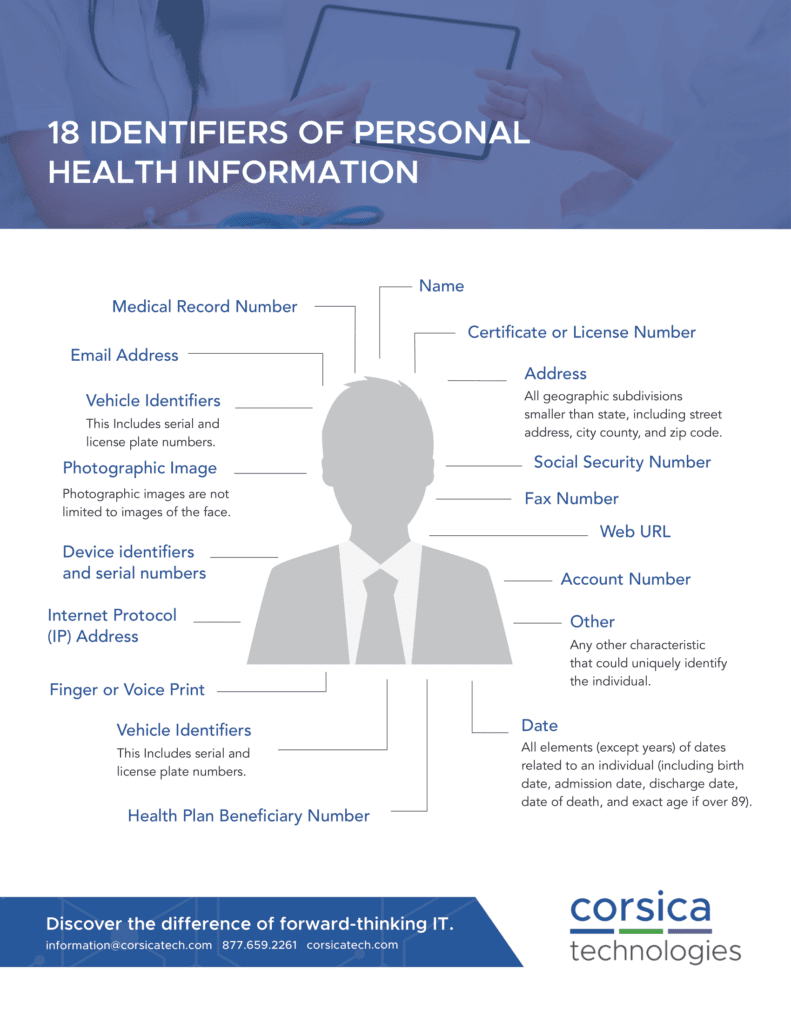
Information collected from an individual by a covered entity that relates to the past, present, or future health or condition of an individual and that either identifies the individual or there is basis to believe that the information can be used to identify, locate, or contact the individual.
HITECH stands for the Health Information Technology for Economic and Clinical Health (HITECH) Act. President Obama signed it into law on February 17, 2009.
The HITECH Act provided over $30 billion for healthcare infrastructure and the adoption of electronic health records (EHR). According to the Act, physicians were eligible to receive up to $44,000 per physician from Medicare for meaningful use of a certified EHR system starting in 2019. This support expired in 2021.
Any business entity that electronically processes, stores, transmits, or receives medical records, claims or remittances must comply with HIPAA. This can include organizations such as staffing companies, HR departments, and other entities outside of a standard healthcare facility.
HIPAA requirements preempt state laws if they require shorter periods of document retention. HIPAA compliance states you must retain required documentation for six years from the date of its creation or the date when it last was in effect.